A capital improvement plan (CIP) is a public agency's multi-year schedule of capital projects, with each project's cost, funding source and timing by year. For an engineering firm, it's the earliest public sign that design or construction work is coming. Read the phase and funding columns, and a CIP becomes a 12- to 24-month pursuit list.
Most firms know their clients publish one. Fewer read past the summary table. The useful information is in the project pages, one line at a time.
What Is a Capital Improvement Plan?
A CIP lists the capital projects a county, city, utility or authority plans to fund over the next several years. The Government Finance Officers Association recommends a plan covering "five to 25 years or more" that "establishes project scope and cost, details estimated amounts of funding from various sources, and projects future operating and maintenance costs."
In practice, most local CIPs run five or six years. Three real examples:
- Loudoun County, Virginia adopted a six-year CIP for FY 2027 through FY 2032 totaling about $4.3 billion, $1.8 billion of it for transportation. It rebuilds the six-year window every other year.
- Cecil County, Maryland approved its FY 2027 CIP on July 1, 2026. It covers FY 2027 through FY 2031, with one project form per project.
- Dakota County, Minnesota prepares "a five-year Capital Improvement Program (CIP) that includes a one-year capital budget" every year. Its draft 2027–2031 program is posted now, with $521 million of transportation projects over five years.
The format differs, but the core is the same: a project, its phases, its cost by year and where the money comes from.
How Is a CIP Different From a Capital Budget, a TIP and a STIP?
These four documents get mixed up, and each tells you something different about whether money is real.
| Document | Who adopts it | Horizon | What it tells you |
|---|---|---|---|
| Capital budget | County or city board | One year | Money actually appropriated this fiscal year |
| Capital improvement plan (CIP) | County or city board | Usually 5–6 years | Planned projects and funding. Only the first year is appropriated |
| Transportation improvement program (TIP) | Metropolitan planning organization | 4 years | Metro-area transportation projects that need federal funding |
| Statewide transportation improvement program (STIP) | State DOT | 4 years | The statewide program, consistent with the TIPs |
The capital budget and the CIP are usually one document. Loudoun says it plainly: the CIP "does not constitute or require appropriation of funds beyond those for the adopted fiscal year." Projects in the later years "provide only planned appropriations and are subject to change in subsequent budget development cycles."
The TIP and STIP are federal planning documents. Under 23 CFR 450.104, each covers four years and is "required for projects to be eligible for funding" under the federal highway and transit titles. Both must be fiscally constrained for each program year. A county road project that counts on federal money should also appear in the TIP, or the STIP outside a metro area. If it's only in the CIP, ask why.
When Do Agencies Publish Their CIPs?
It follows the agency's fiscal year, so the reading season depends on the client.
- July 1 fiscal year (common for counties and cities). Loudoun's administrator presents the proposed budget in February, the board holds work sessions in February and March, and adoption comes in April. Cecil's CIP was approved July 1. For these clients, the proposed CIP is the one to read, and it comes out between February and April.
- Calendar fiscal year. Dakota County sends a draft CIP to cities and townships in September, reviews it with the county board at a November budget workshop, then holds a public hearing and adopts it in December with the annual budget. Its 2027–2031 draft was posted in October 2026.
- Biennial. Loudoun rebuilds its six-year window every other year. The off-year update still changes project timing, so read both.
Add the publication dates to your calendar for your top clients. Read the draft or proposed version when it posts. It comes out months before the adopted one, and you can check what changed at adoption.
Which CIP Columns Predict a Solicitation?
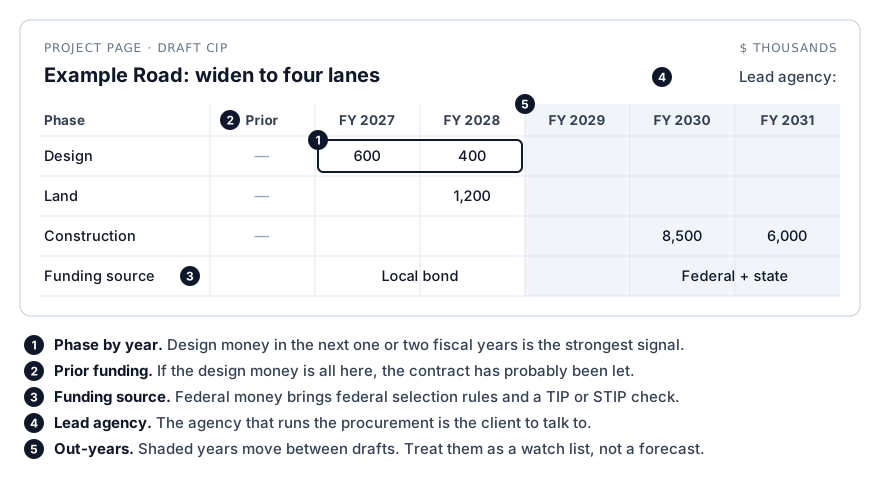
Five things on a project page tell you whether a solicitation is coming and when.
- Phase by year. Loudoun's project pages show a "Project Phase Timeline by FY" for design, land and construction. It defines design as "preliminary and final design" carried in the professional services line. Cecil's forms split each project into Design/Engineering, Land Acquisition, Site Work and Construction by fiscal year. A design line in the next one or two fiscal years is the strongest signal on the page.
- Prior funding versus future years. Cecil's forms show a "Prior Funding" column. If all the design money is in prior funding, the design contract has probably been let. Cecil's Glebe Road Bridge shows exactly that: design and construction fully funded in prior years, and the page notes the project "was awarded for construction winter 2026." That one's gone.
- Funding source. Federal and state columns change the procurement rules and the calendar. Federal-aid highway design follows the selection rules in 23 CFR 172, and the project has to clear the TIP or STIP first. Local bond or sales tax money follows the agency's own procurement code.
- Lead agency. Dakota County's tables name a lead agency on every project. Most are the county, but some are led by a city or by the state DOT. The CSAH 26 roundabout at US 52 lists MnDOT as lead, and the CSAH 9 signal at Glacier Way lists the City of Lakeville. The lead agency runs the procurement, so that's the client to talk to.
- Out-year confidence. Later years move. Loudoun builds planning contingencies of 5% to 40% into re-estimated projects to account for market uncertainty. Treat years three to six as a watch list, not a forecast.
A Worked Example: One Line in a Draft County CIP
Dakota County's draft 2027–2031 CIP includes project 99-013, "CSAH 46: TH 3 to 1,300 feet east of CR 48 - Reconstruct," in Coates, Empire and Rosemount, with Dakota County as lead agency.
| Year | Annual cost | Funding shown |
|---|---|---|
| 2027 | $500,000 | $462,500 transportation sales tax, $37,500 city |
| 2029 | $44,940,000 | $19,508,250 county state-aid (CSAH), $13,850,000 state, $10,000,000 federal, $1,581,750 city |
Here's how to read it:
- A small line two years before a large one. The summary table doesn't say what the 2027 money buys. Early work such as design or right-of-way is the usual pattern, but ask the county before you count it. Ask whether a consultant is already on it.
- Federal and state money in the construction year. About $23.9 million of the 2029 line is state and federal. Ask whether any federal funds will reach design, because that decides which selection rules apply.
- County lead. The procurement, if there is one, runs through Dakota County's transportation department.
That's one row. The same draft has five years of rows across preservation, management, replacement and expansion. Most will be routine, but some will look like this one.
How Do You Turn Client CIPs Into a 12-Month Pursuit List?
Start with three clients, not thirty. The method scales once it works.
- Pick three clients you already know. Pull each one's current adopted CIP and, if it's out, the draft or proposed version.
- Filter to your disciplines. Roads, bridges, drainage, water, facilities, whatever you actually sell.
- Flag every line with design or land money in the next two fiscal years, plus any small early line ahead of a large construction year.
- Record six fields per line: project, phase, fiscal year, amount, funding source and lead agency. Note whether design is already in prior funding.
- Cross-check federal projects against the TIP or STIP. No TIP entry means the federal money isn't programmed yet.
- Score each line with your go/no-go framework. Drop lines where design is already funded in prior years, unless you sell construction-phase services.
- Talk to the client before the RFQ. A CIP line is a reason to call. We covered what to ask in client research before the RFP.
- Re-read at the next draft. Out-years move. Keep the list, update the dates.
The result is a short list of named projects with a fiscal year attached. That's what makes a pipeline usable for staffing and hiring decisions, not just for business development. When a line on the list turns into an RFQ, the next question is which of your own projects and people fit it. RFPM's Ask RFPM Agent answers that from your firm's records, with links to the source.
What Doesn't a CIP Tell You?
A CIP is a funding plan, not a procurement schedule. Four gaps to fill by other means:
- Whether a consultant is already in place. Many agencies run design through on-call contracts, so a funded design line may become a task order, not an open RFQ.
- When the solicitation posts. The fiscal year tells you when money becomes available, not the advertisement date.
- What the project page leaves out. Summary tables often show only totals. Read the project pages, and check the units. Cecil's tables are in thousands of dollars.
- Whether the money will hold. Later years depend on future budgets, bond sales and grants. Read our notes on funding concentration in go/no-go decisions before you count on federal-heavy lines.
Frequently Asked Questions
What is the difference between a CIP and a capital budget?
The capital budget is the first year of the CIP, and it's the only year with money actually appropriated. The later years are planned funding that the governing board can change in each budget cycle. Loudoun County's adopted CIP, for example, says later-year projects "provide only planned appropriations and are subject to change."
How far ahead does a capital improvement plan show projects?
Usually five or six years. Loudoun County's covers FY 2027 through FY 2032, and Dakota County's draft covers 2027 through 2031. GFOA recommends a multi-year capital plan of five to 25 years or more. The first one or two years are the most reliable.
Where do I find a county's capital improvement plan?
On the budget or finance page of the county or city website, usually under the current budget year. Look for the proposed or draft CIP as well as the adopted one. Calendar-year counties post drafts in the fall. Counties on a July fiscal year usually propose theirs between February and April.
Does a project in the CIP mean an RFQ is coming?
Not necessarily. The design may already be funded and under contract, the agency may use an on-call consultant, or the out-year money may move. A design or land line in the next one or two fiscal years, with no prior design funding, is the strongest sign. Confirm it with the client.