How to Prepare for an Engineering Shortlist Interview
A shortlist interview is the agency's second, separately scored look at your team. Read the notice, pick presenters, plan the minutes, and rehearse for Q&A.
In this article
- What Is a Shortlist Interview?
- Does the Interview Decide the Award?
- What Formats Do Agencies Use for Shortlist Interviews?
- How to Prepare for a Shortlist Interview
- How Much Time Do You Have to Prepare?
- How to Prepare for Shortlist Interview Questions
- What Should You Bring to a Shortlist Interview?
- Why Shortlist Interviews Strain Proposal Capacity
- Frequently Asked Questions
A shortlist interview is the step where an agency meets the top-ranked firms from a qualifications round before it picks one. It's usually 15 to 75 minutes, split between a prepared presentation and questions. Many agencies rank the interview on its own, so preparation means reading the notice closely, bringing the people who will do the work, and rehearsing the Q&A.
What Is a Shortlist Interview?
It's the second stage of qualifications-based selection. The agency scores the written submittals, ranks the firms, and invites the top few to talk. Federal rules make that conversation mandatory: under FAR 36.602-3, the evaluation board must "hold discussions with at least three of the most highly qualified firms." Florida's Consultants' Competitive Negotiation Act requires discussions with no fewer than three firms and lets the agency require public presentations.
Most state DOTs, counties and universities use the same pattern. The qualifications-based selection overview covers the whole process. This guide covers the part after you make the cut.
Does the Interview Decide the Award?
Often it does, because some agencies rank the interview separately. Washington's Department of Enterprise Services (DES) publishes a scoresheet for each facility consultant selection. It shows a Phase 1 rank from the statements of qualifications and a final rank from the Phase 2 interview.
We read ten DES scoresheets from December 2024 to February 2026. Nine had more than one firm interviewed:
- In one, the interview reversed the result. On a fire protection project scored in December 2024, all five panelists ranked the same firm first on the SOQs. Ten days later, after the interviews, three of the five ranked the firm that had been third on paper first. It won, and the SOQ leader finished second.
- In three more, the interview reordered the firms below the winner. Second and third swapped, or third and fourth. That still matters, because the agency negotiates with the next firm if talks with the first one fail.
- In five, the order held.
The interview scores were close. One panelist in the December 2024 selection scored the three firms 94.25, 94.00 and 93.75 out of 100, on four criteria worth 25 points each: organization, project management, project approach and experience. A quarter of a point separated each place.
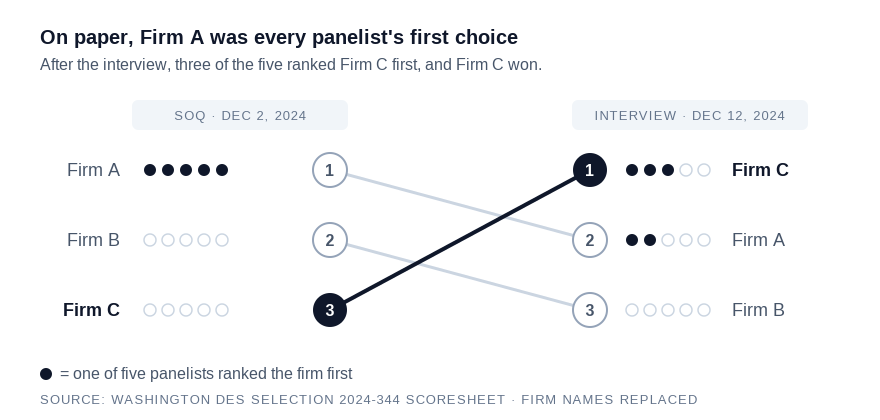
So treat the interview as a new competition between firms that are already close. Your SOQ's qualifications got you into the room. The interview is scored on what the panel sees there.
What Formats Do Agencies Use for Shortlist Interviews?
The format is in the shortlist notice, and it varies a lot. Five notices we read:
| Agency and contract | Length and split | Who attends | Files and materials |
|---|---|---|---|
| Wisconsin DOT, Engineering Opportunity Day 2026 | 30 minutes: 25 presenting, 5 Q&A. In person | Firm's choice, but "all team members should participate" | PDF due by 8:00 am the day before. Bring a projector. No paper |
| Nebraska DOT, RFQ-2508 (Papillion street project, 2025) | 15-minute presentation, then up to 10 minutes of Q&A | Not specified | Slides as a PDF by 8:30 am on the day |
| Nebraska DOT, RFQ-2524 (on-call public involvement, 2026) | A call of "no more than 15 minutes" on the criteria | Not specified | None. NDOT scores the criteria after the calls |
| MoDOT sample interview letter (Engineering Policy Guide) | 10-minute presentation, ~30 minutes Q&A, 5-minute close | Four people, one of whom "must be the proposed project manager" | No presentation materials allowed |
| Penn State design-build interview (2017) | 40 minutes presenting, 35 minutes Q&A | Seven people at most. Executives who won't work the job "should not attend" | A copy of the presentation, plus full resumes of everyone attending |
Three things change from notice to notice: the share of time that's Q&A, who must attend and who may not, and what you can show or hand over. The Q&A share in this set runs from 17% at Wisconsin to about two-thirds in the MoDOT letter. A team that rehearses only the presentation is ready for a third of the MoDOT interview.
How to Prepare for a Shortlist Interview
- Turn the notice into a checklist. Write down the time limit and split, the team cap, required attendees, the file format and deadline, the naming rule, and what you may bring. Wisconsin's file name alone has five parts. Missing the PDF deadline is an avoidable loss.
- Bring the people who will do the work. Panels want the project manager and the leads they'll work with every day. MoDOT's letter requires the PM. Penn State asks executives who won't stay on the job to stay home. Everyone in the room should appear on your proposal org chart, in the role it shows. Changing them later is a substitution request, not a casting choice.
- Don't re-present the SOQ. Nebraska's notice says the panel "will be well versed" in the SOQ's organization and technical responses and asks firms not to spend much time on them. MoDOT's letter says "very little" time should go to past experience. Build the talk around what the panel can't get from paper: how this team will handle this project's risks.
- Answer the topics the agency names. Nebraska listed four for RFQ-2508: staff management, drainage design restrictions, access management on the corridor, and environmental challenges. When the notice names topics, give each one its own slide and its own presenter.
- Map the talk to the scoring criteria. If the criteria aren't in the notice, look for them in the RFQ or on the agency's page. Washington DES scored organization, project management, approach and experience equally. Wisconsin's partial list of interview criteria asks about WisDOT experience, meeting deadlines, coordinating with other agencies, and "staff qualifications and availability."
- Budget the minutes. Give every section a time and an owner. In a 25-minute slot, that might be 2 minutes of introductions, 15 on approach and risks, 5 on management and availability, and 3 to close. Then cut whatever runs long.
- Rehearse against the clock, then rehearse the Q&A. Run at least two full timed rehearsals with a mock panel of people from outside the pursuit. Spend the second one mostly on questions.
How Much Time Do You Have to Prepare?
Often one to three weeks. On the Washington scoresheets, the panel's SOQ scoring and the interviews were 7 to 27 days apart. Wisconsin published its 2026 interview schedule on January 22 for interviews on February 3. Penn State's screening committee met on October 12, and interviews were on October 30.
A schedule that fits in ten working days:
| When | What to finish |
|---|---|
| Day 1 | Checklist from the notice. Attendees confirmed, calendars cleared |
| Days 2–3 | Storyline: one message per scoring criterion and per named topic |
| Days 4–5 | Draft slides. Each presenter writes their own section |
| Day 6 | First timed run-through. Cut to time |
| Day 7 | Question bank written. Each question assigned to a presenter |
| Day 8 | Second run-through with a mock panel, mostly Q&A |
| Day 9 (or the deadline) | Final PDF named to the convention and submitted. Logistics confirmed |
| Day 10 | Interview |
If you have a week, compress it. Skip slide polish before you skip a rehearsal.
How to Prepare for Shortlist Interview Questions
The notices we read don't publish their questions. Nebraska only tells firms to "be prepared to answer a variety of Committee questions." So build the question bank from the scoring criteria and the project:
- Staff availability. Wisconsin scores it directly. Know what each presenter is working on now and how many hours a week they can give this project.
- Risks and schedule. Expect "What's the biggest risk on this job, and what do you do about it in the first 90 days?" Answer with this project's specifics.
- Agency process. Wisconsin asks whether firms new to it understand WisDOT processes. Have a short answer on the manuals, review cycles and approvals you've worked through.
- Subconsultants. Be ready to say why each sub is on the team and who manages them.
- The work the presenters actually did. Panelists ask about projects on the resumes. The person who did the work answers, not the PM on their behalf.
Assign every likely question to one presenter. Agree who takes anything unexpected. A team that talks over itself loses points under "organization."
What Should You Bring to a Shortlist Interview?
Only what the notice allows. Wisconsin needs no paper copies. MoDOT's letter allows no presentation materials beyond the documents the agency supplies. Penn State asked for a copy of the presentation and full resumes for everyone attending.
That last request is common enough to plan for. Bring current resumes for every attendee, consistent with what you submitted. If your resumes and project records live in one place, such as a proposal workspace like RFPM, that's a print job rather than a weekend.
Why Shortlist Interviews Strain Proposal Capacity
The interview pulls in the most senior people at the firm: the PM, the discipline leads, often a principal. Those are the same people writing approach sections for the next SOQ. Our proposal capacity math puts a major pursuit with interview preparation at 35 to 45 SME hours as a starting estimate, against 8 to 12 for a standard SOQ.
So a shortlist is also a capacity decision. Firms that keep resumes, project sheets and past answers ready to reuse spend those senior hours on rehearsal, not on rebuilding documents. That's where interviews are won.
Frequently Asked Questions
How long is a shortlist interview?
Usually 15 to 75 minutes. In the notices we read, Nebraska DOT allowed a 15-minute presentation and up to 10 minutes of questions, Wisconsin DOT gave 30 minutes, and a Penn State design-build interview ran 75 minutes. The shortlist notice sets the format, so read it before you plan anything.
Who should attend a shortlist interview?
The project manager and the leads who will do the work. Some agencies require the PM by name, cap the team at four to seven people, or ask executives who won't stay on the project not to attend. Everyone in the room should match the org chart and key personnel you submitted.
Do SOQ scores carry into the interview?
It depends on the agency, and the RFQ should say. Washington's Department of Enterprise Services ranks the interview separately, and in one December 2024 selection the firm ranked third on its SOQ won. Plan as if the interview starts from zero.
What do panels ask in a shortlist interview?
Agencies rarely publish their questions. Expect them to follow the scoring criteria: staff availability, project risks and schedule, experience with the agency's processes, the subconsultant team, and the projects on the resumes. Assign each likely question to the presenter who knows the answer.
Read next
What an IIJA Extension Means for Your 2027 Pipeline
FHWA August Redistribution: What It Means for A/E Firms
Proposal Activity Is Up Because Backlogs Thinned First